A practical guide for retailers and distributors on the EU’s Packaging and Packaging Waste Regulation (PPWR) — a new EU-wide regulation designed to reduce packaging waste and improve recycling performance. Understand what is changing, what is required, and how to turn compliance into a competitive advantage before 2029
Executive Summary
- The 2029 Mandate: The EU’s PPWR requires a 90% collection rate for beverage containers by 2029 — a significant step-change from current performance levels.
- The Real Challenge: Achieving 90% is not a packaging issue; it is a collection and system performance challenge.
- Retailer Responsibility: Compliance is shifting to the point of sale, placing retailers at the centre of collection infrastructure.
- Business Opportunity: High-performing collection systems increase foot traffic, strengthen customer loyalty, and enable data-driven operations.
- Market Shift: For distributors and solution providers, PPWR is driving demand for scalable, performance-driven collection systems across retail networks.
Why the Status Quo is No Longer an Option
The PPWR is the most significant overhaul of EU recycling legislation in a generation. It introduces binding targets that will reshape how retailers operate.
By 2029, member states must achieve a 90% collection rate for beverage containers. For many organisations, the gap between current performance and this target is substantial.
This is not just a regulatory requirement — it is an operational shift that requires recycling to expand beyond traditional supermarket environments into convenience stores, kiosks, and urban locations where consumers actually are.
The real risk is not non-compliance on paper, but failure to achieve collection rates in practice.
To understand why, it is important to look at how the system actually works in practice:
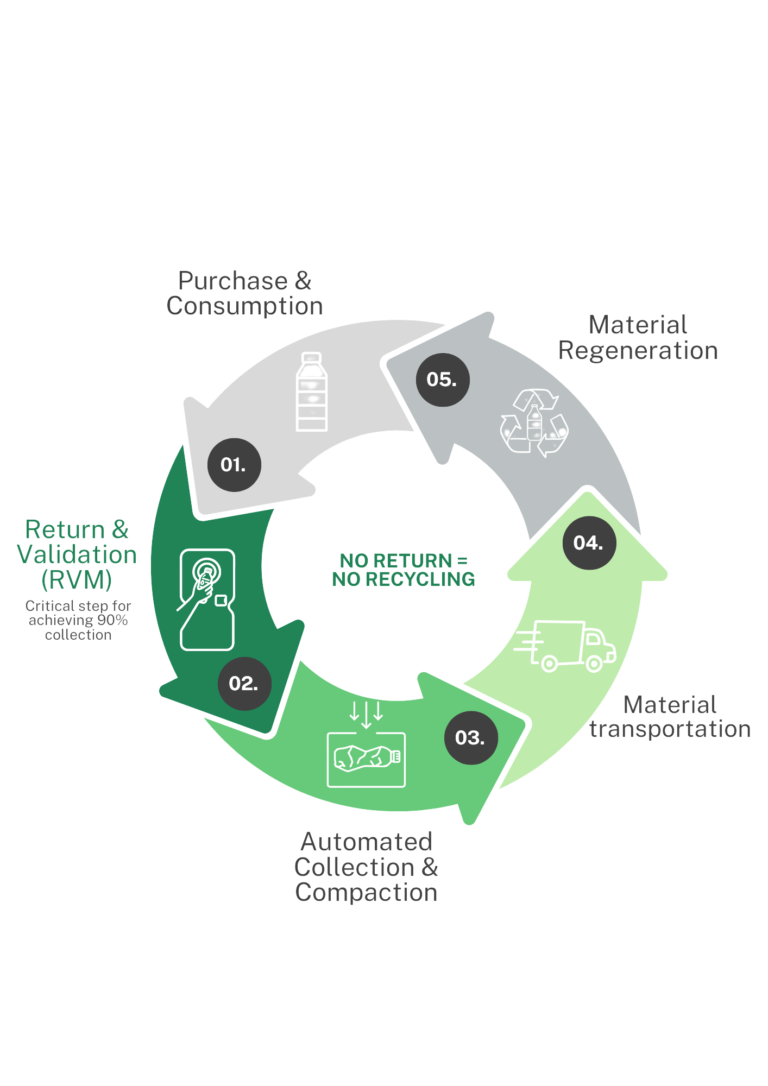
As the diagram shows, recycling performance is determined by collection efficiency. Without effective return systems, even fully recyclable packaging will fail to be recycled in practice.
Compliance Meets Reality: What Changes for Your Business?
The PPWR extends compliance obligations to the point of sale, placing retailers at the centre of collection infrastructure.
Businesses must prepare for three key requirements:
Mandatory Take-Back: Retailers may be required to accept returns of containers sold on-site.
Digital Transparency: Reporting must be automated and data-driven.
Consumer Infrastructure: Accessible, efficient return points are becoming a driver of foot traffic and customer experience.
For retailers, this is not only a compliance burden — it is a structural opportunity.
Retailers that invest early in effective collection systems can increase foot traffic, improve customer loyalty, and strengthen their data capabilities.
Retailers are no longer just points of sale; they are becoming critical nodes in the collection infrastructure.
Turning a Mandate into a Strategic Advantage
Under PPWR, compliance becomes a performance question.
Retailers that implement high-performing collection systems can convert compliance into measurable business value. For distributors, this represents a shift in demand — from standalone products to integrated, performance-driven solutions.
Customer Engagement
Consumers who return containers tend to spend more per visit. A well-designed return experience becomes a recurring touchpoint that drives store visits and loyalty.
Operational Efficiency
Compact, efficient collection systems minimise space requirements and allow retailers to repurpose space for revenue-generating activities. On-site compaction reduces storage needs and logistics costs.
Data-Driven Compliance
Automated systems enable real-time reporting, transaction tracking, and audit-ready data.
Technology alone does not create performance; however, without the right infrastructure, performance is impossible.
Ready to Deep Dive?
The 2029 deadline is not just a milestone — it is a performance threshold.
Download our strategic insight to understand what it takes to achieve 90% collection rates in practice.
Next Steps for Your Team
To prepare for PPWR, organisations should:
- Audit your space to identify high-traffic return points
- Evaluate data and reporting requirements
- Focus on actual return rates, not theoretical compliance
- Ensure solutions can scale with national DRS frameworks
- For distributors, this means aligning product offering, technical capabilities, and partnerships with evolving regulatory and system requirements.
The organisations that understand collection as infrastructure — not obligation — will define the winners of PPWR.